Comparing 401k vs IRA for Retirement Savings
Understand the differences and benefits of 401k and IRA accounts to optimize your retirement savings strategy.
Understand the differences and benefits of 401k and IRA accounts to optimize your retirement savings strategy.
Comparing 401k vs IRA for Retirement Savings
Understanding Retirement Accounts Basics
Hey there, future retiree! Let's talk about something super important for your golden years: retirement accounts. Specifically, we're diving deep into two of the most popular options out there: the 401(k) and the Individual Retirement Account (IRA). You might have heard these terms thrown around, but do you really know what they are, how they work, and which one (or both!) is best for you? Don't sweat it if the answer is no. That's exactly what we're here to figure out. Think of these accounts as special savings vehicles designed to help you build a nest egg for when you decide to stop working. They come with some pretty sweet tax advantages, which can make a huge difference in how much money you end up with. But like anything in personal finance, there are nuances, pros, and cons to each. Let's break it down in a way that's easy to understand, so you can make informed decisions about your financial future.
401k Explained Your Employer Sponsored Plan
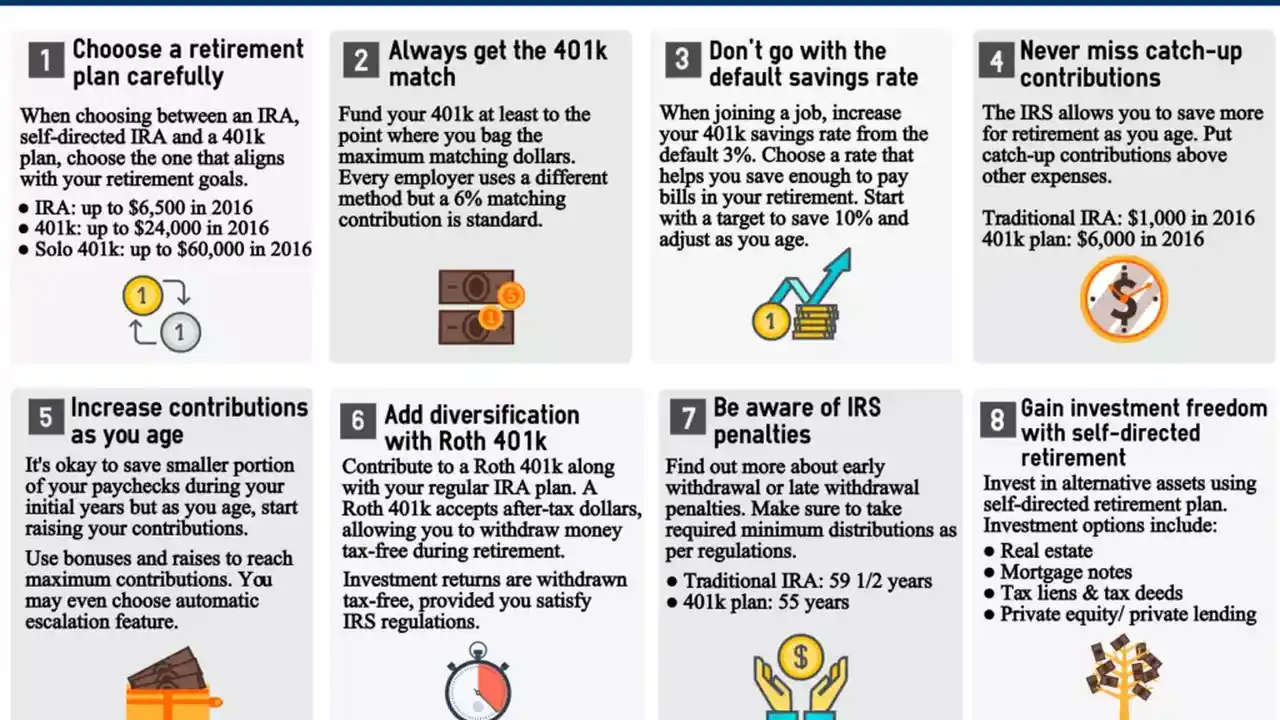
Alright, let's kick things off with the 401(k). This is probably the most common retirement plan you'll encounter, especially if you work for a larger company. A 401(k) is an employer-sponsored retirement savings plan. This means your employer sets it up, and you contribute money directly from your paycheck before taxes are even taken out. Pretty neat, right? This pre-tax contribution is a big deal because it lowers your taxable income for the year, which could mean a smaller tax bill now. Your money then grows tax-deferred, meaning you don't pay taxes on the investment gains until you withdraw the money in retirement. Many employers also offer a matching contribution, which is essentially free money! If your employer matches, say, 50 cents on every dollar you contribute up to 6% of your salary, you'd be crazy not to take advantage of that. It's an instant 50% return on your money, just for saving. However, 401(k)s often come with a limited selection of investment options, usually a curated list of mutual funds or exchange-traded funds (ETFs) chosen by your plan administrator. You also can't contribute as much as you want; there are annual contribution limits set by the IRS. For 2024, the limit is $23,000, with an additional catch-up contribution of $7,500 for those aged 50 and over. Withdrawals before age 59½ are generally subject to a 10% penalty, plus ordinary income tax. So, it's definitely a long-term play.
Popular 401k Providers and Their Features
While you typically don't choose your 401(k) provider directly, it's good to know who the big players are and what they generally offer. These providers work with your employer to manage the plan. Here are a few prominent ones:
- Fidelity Investments: Fidelity is a giant in the retirement space. They offer a wide range of investment options within their 401(k) plans, often including low-cost index funds and target-date funds. Their online platform is generally user-friendly, providing tools for planning and tracking. They also have strong customer service.
- Vanguard: Known for its low-cost index funds and ETFs, Vanguard is a favorite among passive investors. Their 401(k) plans often feature a strong selection of their own highly-regarded funds, which can keep your investment expenses down. Their philosophy is about long-term, low-cost investing.
- T. Rowe Price: T. Rowe Price is well-known for its actively managed mutual funds. Their 401(k) offerings often include a variety of their proprietary funds, managed by experienced portfolio managers. They also provide robust educational resources and planning tools.
- Empower Retirement (formerly Great-West Financial): Empower is one of the largest retirement plan recordkeepers in the U.S. They offer a broad range of investment options and digital tools for participants, focusing on personalized guidance and financial wellness.
- Principal Financial Group: Principal offers a comprehensive suite of retirement solutions for businesses of all sizes. Their 401(k) plans typically include a diverse selection of investment choices and resources to help employees manage their retirement savings.
When considering a 401(k) plan, look at the investment options available, the fees associated with those investments, and any employer match. The employer match is often the most compelling reason to contribute to a 401(k) first.
IRA Explained Your Personal Retirement Account
Now, let's shift gears to the IRA, or Individual Retirement Account. Unlike a 401(k), an IRA is something you set up yourself, independently of your employer. This gives you a lot more control and flexibility. There are two main types of IRAs: Traditional IRAs and Roth IRAs. Both allow your investments to grow tax-deferred (Traditional) or tax-free (Roth), but they differ in when you get your tax break.
Traditional IRA Pre-Tax Contributions Tax Deferred Growth
A Traditional IRA works similarly to a traditional 401(k) in terms of tax treatment. Your contributions might be tax-deductible in the year you make them, which again, lowers your current taxable income. Your investments grow tax-deferred, and you pay taxes on your withdrawals in retirement. The deductibility of your contributions depends on whether you or your spouse are covered by a retirement plan at work and your Modified Adjusted Gross Income (MAGI). For 2024, the contribution limit for Traditional and Roth IRAs combined is $7,000, with an additional $1,000 catch-up contribution for those aged 50 and over. The big advantage here is the potential for an upfront tax deduction and the flexibility to invest in almost anything you want: stocks, bonds, mutual funds, ETFs, even real estate (through a self-directed IRA, though that's more complex). The downside is that your withdrawals in retirement will be taxed as ordinary income.
Roth IRA After Tax Contributions Tax Free Growth
The Roth IRA is a game-changer for many. With a Roth IRA, you contribute money that you've already paid taxes on (after-tax contributions). The magic happens later: your investments grow completely tax-free, and qualified withdrawals in retirement are also 100% tax-free. This is incredibly powerful, especially if you expect to be in a higher tax bracket in retirement than you are now. There are income limitations for contributing directly to a Roth IRA. For 2024, if your MAGI is above certain thresholds, you might not be able to contribute directly, but you can often use the 'backdoor Roth' strategy. The contribution limits are the same as for Traditional IRAs ($7,000 for 2024, plus $1,000 catch-up). The main benefit is that tax-free growth and withdrawals, which can save you a ton of money over decades. The downside is no upfront tax deduction.
Popular IRA Providers and Their Features
Since you open an IRA yourself, you have a lot of choices when it comes to providers. Here are some of the best, known for their low fees, wide investment selections, and user-friendly platforms:
- Fidelity Investments: Fidelity offers both Traditional and Roth IRAs with a vast selection of investment products, including their own low-cost index funds, ETFs, and a wide array of individual stocks and bonds. Their research tools and educational resources are top-notch, making them great for both beginners and experienced investors. They also have 24/7 customer support.
- Vanguard: As mentioned before, Vanguard is a leader in low-cost investing. They are an excellent choice for IRAs if you prefer a passive investment strategy using index funds and ETFs. Their platform is straightforward, and their expense ratios are among the lowest in the industry.
- Charles Schwab: Schwab provides a comprehensive suite of investment options for IRAs, including commission-free ETFs, mutual funds, and individual securities. They offer excellent customer service, robust research tools, and a user-friendly online experience. They also have physical branches if you prefer in-person assistance.
- M1 Finance: M1 Finance is a unique platform that combines automated investing with customization. You can build a portfolio of stocks and ETFs (they call them 'Pies') and M1 will automatically rebalance and invest new contributions according to your chosen allocations. It's great for those who want a hands-off approach but with more control over their specific investments. They offer Traditional, Roth, and SEP IRAs.
- Merrill Edge: Part of Bank of America, Merrill Edge offers a good balance of self-directed investing and access to Merrill Lynch financial advisors. Their IRA accounts provide access to a wide range of investments, including commission-free online stock and ETF trades. It's a good option if you already bank with Bank of America.
When choosing an IRA provider, consider the investment options you want, the fees (trading commissions, expense ratios of funds), the quality of their research and tools, and customer service.
Key Differences and Similarities 401k vs IRA
Let's put them side-by-side to highlight the main distinctions and commonalities:
Contribution Limits and Flexibility
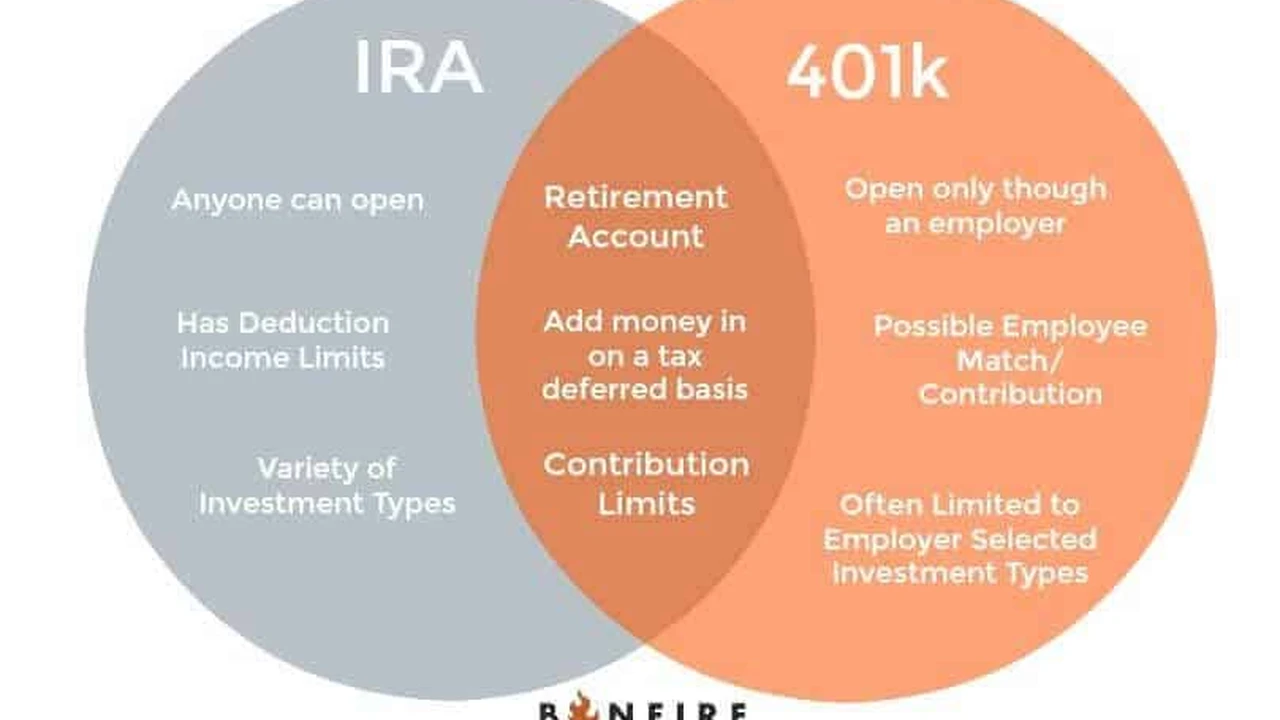
- 401(k): Higher contribution limits ($23,000 for 2024, plus catch-up). Less investment flexibility (limited fund choices).
- IRA: Lower contribution limits ($7,000 for 2024, plus catch-up). Much greater investment flexibility (you choose your investments).
Employer Match and Vesting
- 401(k): Often comes with an employer match, which is free money. May have vesting schedules, meaning you have to work for the company for a certain period to fully own the employer's contributions.
- IRA: No employer match. All contributions are yours immediately.
Tax Treatment and Withdrawals
- Traditional 401(k) / Traditional IRA: Pre-tax contributions, tax-deferred growth, taxable withdrawals in retirement.
- Roth 401(k) / Roth IRA: After-tax contributions, tax-free growth, tax-free qualified withdrawals in retirement.
- Both generally have a 10% penalty for withdrawals before age 59½, with some exceptions.
Control and Management
- 401(k): Managed by your employer's chosen plan administrator. Less control over investment choices.
- IRA: You open and manage it yourself. Full control over investment choices.
Which One Should You Choose Or Both
This is the million-dollar question, and the answer is often: both! Here's a common strategy that many financial experts recommend:
- Contribute to your 401(k) up to the employer match: This is usually the first and most important step. An employer match is an immediate, guaranteed return on your investment that you won't get anywhere else. Don't leave free money on the table!
- Max out your IRA (preferably Roth if you qualify): Once you've secured the employer match in your 401(k), focus on maxing out your IRA. If you expect to be in a higher tax bracket in retirement, a Roth IRA is incredibly powerful due to its tax-free withdrawals. If you're in a higher tax bracket now and expect to be in a lower one in retirement, a Traditional IRA might be more beneficial for the upfront tax deduction. The flexibility and broader investment options of an IRA are a huge plus.
- Go back and contribute more to your 401(k): If you still have money left to save for retirement after maxing out your IRA, go back to your 401(k) and contribute more, up to the annual limit. The higher contribution limits of a 401(k) allow you to save a significant amount of money.
- Consider other investment vehicles: If you've maxed out both your 401(k) and IRA, congratulations! You're doing great. At this point, you might consider other investment accounts like a taxable brokerage account, Health Savings Account (HSA) if eligible (which has triple tax advantages!), or even real estate.
This strategy allows you to take advantage of the employer match, the tax benefits of both types of accounts, and the investment flexibility of an IRA. Your personal situation, including your income, access to a 401(k), and tax bracket, will influence the best approach for you.
Real World Scenarios and Examples
Scenario 1 Young Professional Starting Out
Meet Sarah, 25, just started her first full-time job. Her company offers a 401(k) with a 100% match up to 3% of her salary. She earns $60,000 a year. Sarah should absolutely contribute at least 3% to her 401(k) to get the full employer match. That's $1,800 from her, and $1,800 from her employer – an instant 100% return! After that, she should open a Roth IRA. At 25, she's likely in a lower tax bracket now than she will be in retirement. Contributing to a Roth IRA means her money grows tax-free for decades, and she won't pay a dime in taxes when she withdraws it in retirement. She can contribute up to $7,000 to her Roth IRA. If she still has more to save, she can increase her 401(k) contributions beyond the match.
Scenario 2 Mid Career Professional High Income
John, 40, is a successful software engineer earning $180,000 a year. His company offers a 401(k) with a 50% match up to 6% of his salary. John should contribute at least 6% to his 401(k) to get the full match. Given his high income, he might be phased out of direct Roth IRA contributions. However, he can utilize the 'backdoor Roth IRA' strategy. This involves contributing to a Traditional IRA (where contributions are non-deductible at his income level) and then immediately converting it to a Roth IRA. This allows him to get money into a Roth account for tax-free growth. He should also max out his 401(k) contributions ($23,000 for 2024). If he has additional savings, he might consider a Health Savings Account (HSA) if he has a high-deductible health plan, or a taxable brokerage account.
Scenario 3 Nearing Retirement Self Employed
Maria, 55, is a self-employed graphic designer. She doesn't have access to a 401(k). For her, an IRA is crucial. She can contribute $7,000 plus the $1,000 catch-up contribution to either a Traditional or Roth IRA. Given she's self-employed, she also has other options like a SEP IRA or a Solo 401(k), which allow for much higher contribution limits. A SEP IRA allows her to contribute a significant portion of her self-employment income (up to 25% of net earnings from self-employment, capped at $69,000 for 2024). A Solo 401(k) offers even more flexibility, allowing both employee and employer contributions, potentially reaching the same $69,000 limit. For Maria, exploring these self-employed retirement plans in addition to a regular IRA would be highly beneficial to maximize her retirement savings in her peak earning years.
Important Considerations and Advanced Strategies
Roth 401k vs Traditional 401k
Just like IRAs, many employers now offer a Roth 401(k) option. This works similarly to a Roth IRA: you contribute after-tax money, and qualified withdrawals in retirement are tax-free. The big advantage of a Roth 401(k) is that it has the same high contribution limits as a Traditional 401(k) ($23,000 for 2024), and there are no income limitations for contributing. If your employer offers a Roth 401(k) and you believe you'll be in a higher tax bracket in retirement, it's definitely worth considering, especially if you earn too much to contribute directly to a Roth IRA.
Backdoor Roth IRA Strategy
For high-income earners who are phased out of direct Roth IRA contributions, the 'backdoor Roth IRA' is a popular strategy. It involves contributing non-deductible money to a Traditional IRA and then immediately converting it to a Roth IRA. Since the original contribution was non-deductible, there's no tax on the conversion (assuming you don't have any other pre-tax IRA money – this is known as the 'pro-rata rule' and can complicate things). This allows high earners to still get money into a Roth account for tax-free growth.
Mega Backdoor Roth Strategy
This is an even more advanced strategy, only available if your 401(k) plan allows after-tax contributions and in-service distributions (or rollovers). It involves contributing after-tax money to your 401(k) beyond the regular pre-tax or Roth 401(k) limits, and then immediately converting that after-tax money to a Roth IRA. This allows you to put a significant amount of money into a Roth account, potentially up to the overall 401(k) limit ($69,000 for 2024, including all contributions). This is a complex strategy and requires careful planning and understanding of your specific 401(k) plan rules.
Understanding Fees and Expense Ratios
No matter which account you choose, always pay attention to fees. These can eat into your returns over time. Look for low expense ratios on mutual funds and ETFs (ideally below 0.10% for index funds). Some 401(k) plans might have administrative fees, so be aware of those as well. Even a small difference in fees can amount to tens of thousands of dollars over a few decades.
Diversification and Asset Allocation
Regardless of whether you choose a 401(k), IRA, or both, remember the importance of diversification and asset allocation. Don't put all your eggs in one basket. Spread your investments across different asset classes (stocks, bonds, real estate, etc.) and geographies. Your asset allocation should generally align with your risk tolerance and time horizon. Younger investors can typically afford to take on more risk (more stocks), while those closer to retirement might want a more conservative approach (more bonds).
Regular Review and Adjustments
Your retirement strategy isn't a set-it-and-forget-it kind of deal. Life changes, market conditions change, and your goals might evolve. Make it a habit to review your retirement accounts at least once a year. Check your asset allocation, rebalance if necessary, and ensure you're still on track to meet your goals. Adjust your contributions as your income changes or as contribution limits are updated by the IRS.
Final Thoughts on Your Retirement Journey
Navigating the world of retirement accounts can seem daunting at first, but understanding the basics of 401(k)s and IRAs is a huge step towards securing your financial future. Remember, the best plan is often the one you actually contribute to consistently. Start early, contribute as much as you can, and take advantage of any employer matches. Whether you lean more towards a 401(k) for its simplicity and employer match, or an IRA for its flexibility and control, both are powerful tools for building wealth over the long term. Don't hesitate to seek advice from a qualified financial advisor if you have complex questions or need personalized guidance. Your future self will thank you for taking these steps today!
:max_bytes(150000):strip_icc()/277019-baked-pork-chops-with-cream-of-mushroom-soup-DDMFS-beauty-4x3-BG-7505-5762b731cf30447d9cbbbbbf387beafa.jpg)